Delivery in 3–5 days
Lab tested · every batch
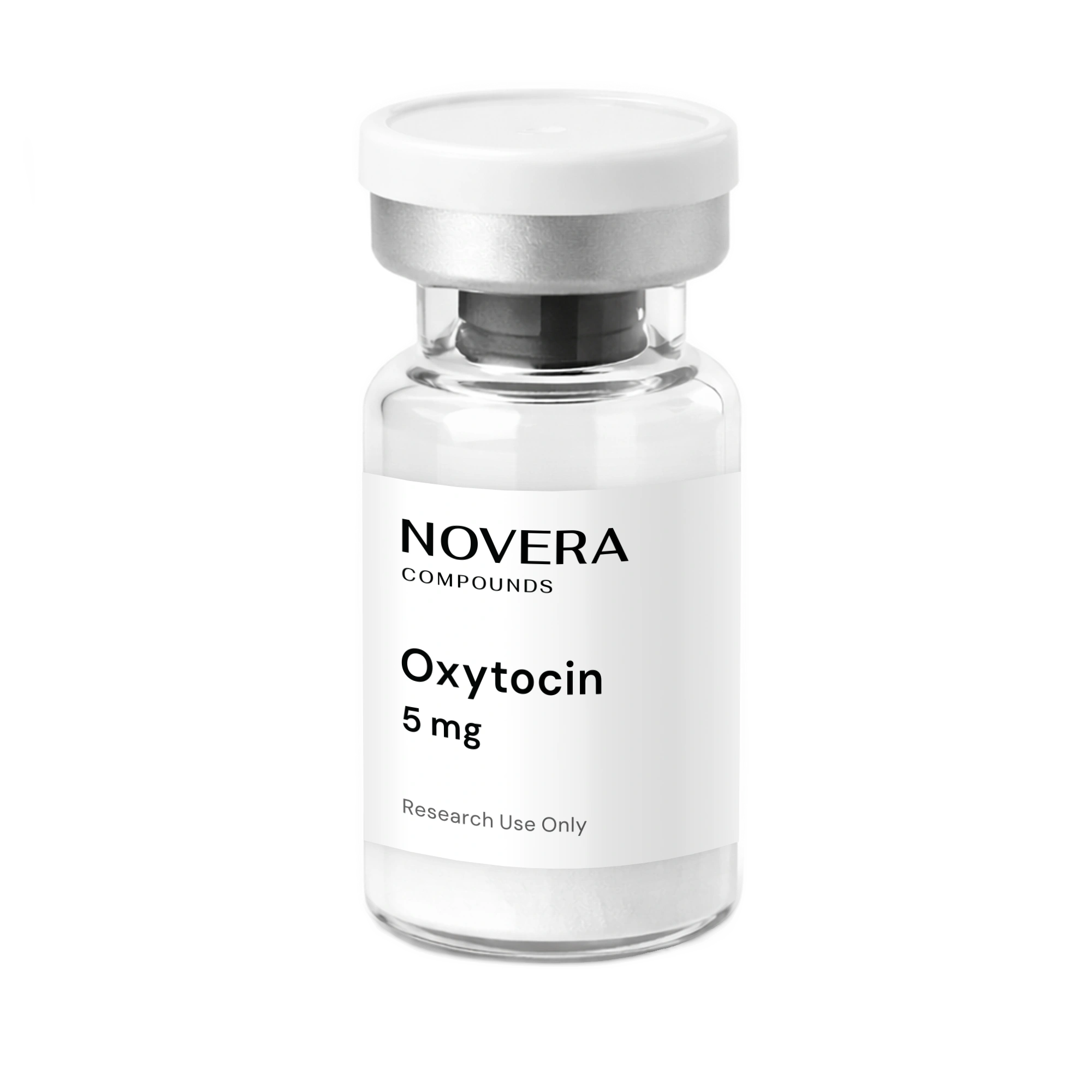
Oxytocin 5mg
Ambient shipping · Express available · 28-day delivery guarantee
Bulk pricing. Buy 6 or more vials and save up to 26% — pick a quantity tier above.
99% Purity Guarantee
Each peptide batch is tested and verified to meet or exceed 98–99% purity (HPLC).
Storage Handling Notice
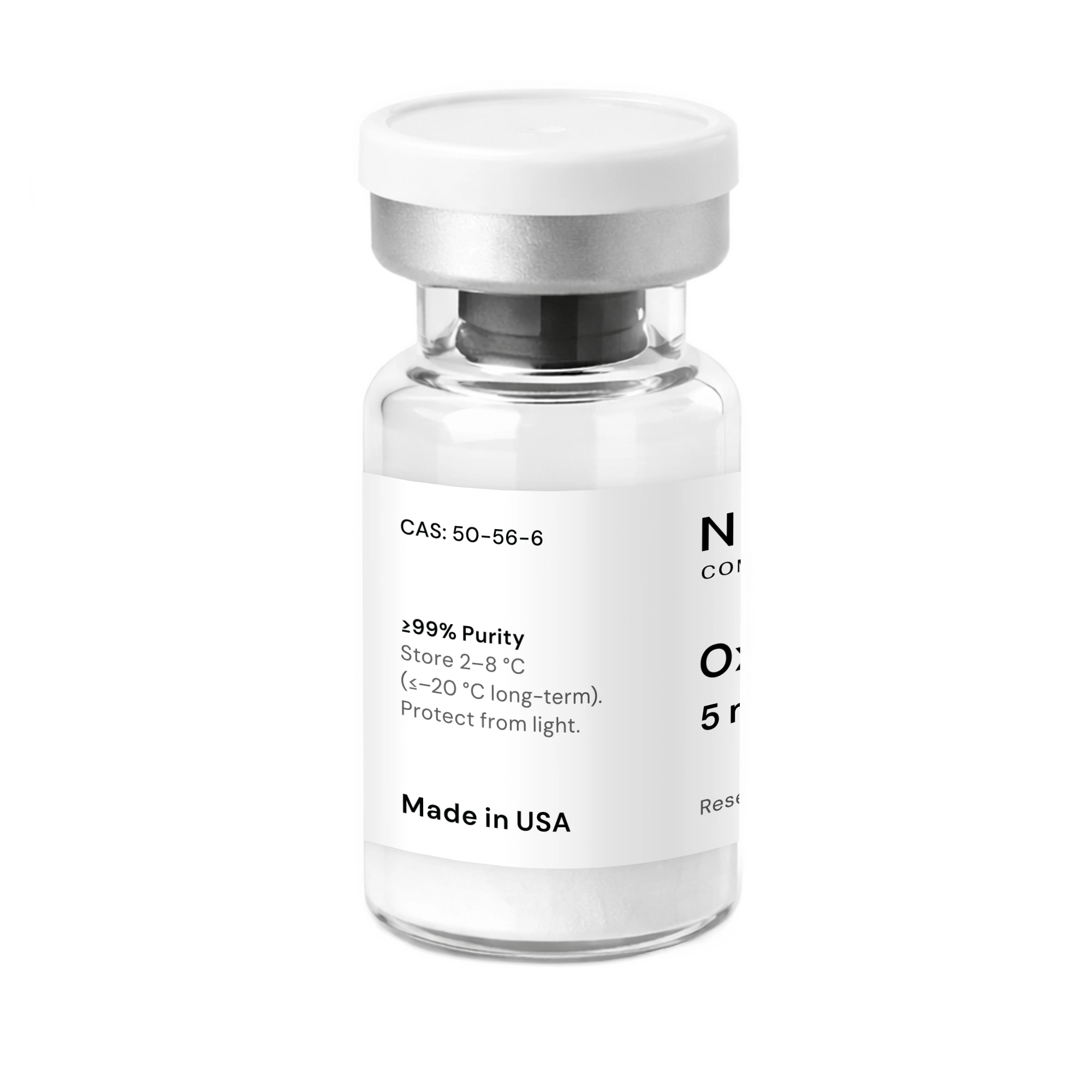
Store 2–8 °C (≤–20 °C long-term). RT exposure during transport acceptable. Protect from light.
Certificate of Analysis (COA)
Sign in to view lab results →Tested for: Purity (HPLC). Lab result PDFs are listed below for signed-in researchers.
1 lab report available to signed-in researchers.
For research and laboratory use only. Not for human or animal consumption.
Oxytocin (5mg) is supplied exclusively for laboratory research use. Institutional and laboratory procurement systems provide access to secure ordering processes designed for research material sourcing.
All shipments are prepared with discreet labeling and protective packaging. Delivery processes are structured for reliability and traceability within research supply chains.
This compound is supplied solely for research purposes and is not intended for clinical, diagnostic, therapeutic, or consumer-related applications.
Product overview
Researchers investigate peptide–receptor interaction models. A receptor is a cellular protein that binds to a specific molecule. Binding may trigger measurable biochemical activity in a test system.
Experimental signaling pathway models are also studied. A signaling pathway is a sequence of molecular events inside cells. These events allow researchers to observe how signals propagate within controlled laboratory systems.
Controlled laboratory peptide stability studies are performed. Stability refers to how well a compound maintains its structure over time. Temperature, light, and environmental exposure are evaluated during testing.
This oxytocin peptide is examined within peptide research environments focused on molecular communication systems. All investigations occur under regulated laboratory conditions.
Research focus
Oxytocin is investigated in research environments that analyze molecular binding dynamics. Binding dynamics refer to how molecules attach to and dissociate from receptors over time.
It is studied within controlled laboratory models designed to measure signaling duration and structural integrity. Laboratory models allow researchers to isolate specific molecular variables.
The compound is explored for experimental peptide research related to structural sequencing. Structural sequencing refers to the arrangement of amino acids within a peptide chain. Small variations in sequence may influence receptor interaction behavior.
Researchers also examine molecular stability in buffered systems. Buffered systems maintain constant chemical conditions, supporting consistent experimental observation.
All studies are conducted strictly for research purposes. No applied or clinical outcomes are implied.
Methodological notes
Store in cool, dry, and light-protected conditions. Refrigeration supports long-term structural stability.
Laboratory handling only. This material must be managed by qualified research personnel.
Avoid exposure to moisture and excessive heat, as environmental stress may affect molecular integrity.
Maintain sealed containment until experimental preparation begins. Use calibrated laboratory instruments for measurement. Controlled documentation procedures are recommended for tracking each research unit.
Quality & sourcing
Each production batch undergoes purity verification procedures. High-performance liquid chromatography is commonly used. This analytical technique separates molecular components to measure peptide purity levels.
Batch-to-batch consistency is documented to ensure each unit matches predefined structural criteria.
Internal quality assurance standards guide synthesis, filtration, and packaging. These standards support research-grade peptide supply reliability.
Quality control testing protocols include identity confirmation and impurity screening. Analytical reports are retained for institutional reference.
The compound is positioned strictly within the research-grade supply category.
Chemical properties
- CAS: 50-56-6
- Chemical Formula: C₄₃H₆₆N₁₂O₁₂S₂
- Molecular Weight: 1007.2 g/mol
- Peptide Sequence: Cys-Tyr-Ile-Gln-Asn-Cys-Pro-Leu-Gly-NH2
- Synonyms: Pitocin, Endopituitrina
- Shelf life: 24 months from the manufacturing date.
Oxytocin is a synthetic peptide composed of a short chain of amino acids. Amino acids are the molecular building blocks of peptides and proteins.
Peptide signaling refers to the way peptides transmit information at the molecular level. This process occurs when a peptide binds to a receptor and initiates a measurable biochemical response. In laboratory research, this response is monitored using analytical instruments.
Signaling peptides are studied because they help researchers understand molecular communication mechanisms. Molecular communication describes how biochemical signals are exchanged within experimental systems. These investigations support broader peptide research objectives.
The oxytocin peptide supplied in this format is manufactured to defined molecular specifications. Identity confirmation is performed using analytical techniques such as mass analysis, which measures molecular weight to confirm structural accuracy.
Key features
- Synthetic research peptide formulation
- Compact format for controlled laboratory research
- High-purity, batch-tested compound
- Secure packaging and discreet shipment
This oxytocin peptide is manufactured through controlled chemical synthesis. Synthetic production means the compound is created in a laboratory rather than extracted from biological sources. The 5mg pack size allows accurate allocation within defined research protocols.
Each batch undergoes peptide purity assessment before release. Peptide purity refers to the percentage of the desired molecular structure compared to impurities. High purity supports reproducible laboratory outcomes.
All materials are sealed in protective packaging. Shipments are prepared for research facilities and institutional laboratory networks.
Research & Education Tool
Peptide Dosage Calculator
Enter the vial amount, diluent volume, and target amount to estimate concentration, draw volume on a 1 mL U-100 syringe, and approximate vial yield.
For research and educational use only. Check all values against the product label, certificate of analysis, and any applicable professional guidance before relying on the result.
mg
Concentration
-
mcg / mL
Volume per Dose
-
-
Estimated Draws / Vial
-
rounded down to whole draws
Draw Reference
Enter values to estimate the syringe mark.
0
-
-
-
-
Express Tracked Shipping — $25
Prices:
- Flat $25 per order
- Ambient shipping, safe for lyophilized peptides
Regular Tracked Shipping — $15
Delivery in 5–10 days
Prices:
- Flat $15 per order
- Free on monthly Build a Box orders
What is Oxytocin and what receptor does it engage in research models?
Oxytocin is a nonapeptide neurohormone produced in the hypothalamus. It acts as an agonist at the oxytocin receptor (OTR) — a Gq-coupled GPCR expressed in the uterus, mammary gland, brain, heart, and immune tissue. In research, synthetic oxytocin is used as a reference agonist for OTR pharmacology, in reproductive cell signalling studies, and in neuroscience research on social behaviour-related signalling pathways.
What signalling pathways does OTR activation engage in research?
OTR is primarily Gq-coupled and activates phospholipase C, generating IP3 and DAG. IP3 releases intracellular calcium, producing the smooth muscle contraction responses characterised in uterine and myoepithelial research models. OTR also engages Gi in some cell contexts, reducing cAMP. In neuronal research models, OTR activation modulates dopamine, serotonin, and GABA neurotransmitter system interactions through intracellular signalling cross-talk mechanisms.
How is Oxytocin characterised analytically as a research compound?
Oxytocin is a cyclic nonapeptide with a disulfide bridge between Cys1 and Cys6. Identity confirmation requires mass spectrometry verifying a molecular weight of 1007.2 Da and confirmation of the disulfide-cyclised form versus the reduced linear form. HPLC purity documentation and biological activity verification in a receptor-based functional assay (typically calcium mobilisation in OTR-expressing cells or in vitro uterine contraction assay) are standard quality requirements for research-grade oxytocin.
What research models use Oxytocin as a pharmacological tool?
OTR pharmacology research uses Gq biosensor assays and IP1 accumulation assays in OTR-expressing cells. Calcium imaging in primary hypothalamic neurons characterises oxytocin’s electrophysiological effects in neuronal models. Receptor selectivity profiling against the structurally similar vasopressin receptors (V1aR, V1bR, V2R) is essential for attributing effects specifically to OTR activation. Competitive binding assays using radiolabelled oxytocin characterise antagonist affinity at OTR.
Is Oxytocin from Elivena approved for clinical or obstetric use?
Oxytocin as supplied by Elivena is for research use in controlled laboratory settings only. It is not a pharmaceutical-grade product approved for clinical, obstetric, or human therapeutic administration. Research compounds are not manufactured to the sterility, pyrogenicity, or potency standards required for human injectable medicines.