
Delivery in 3–5 days
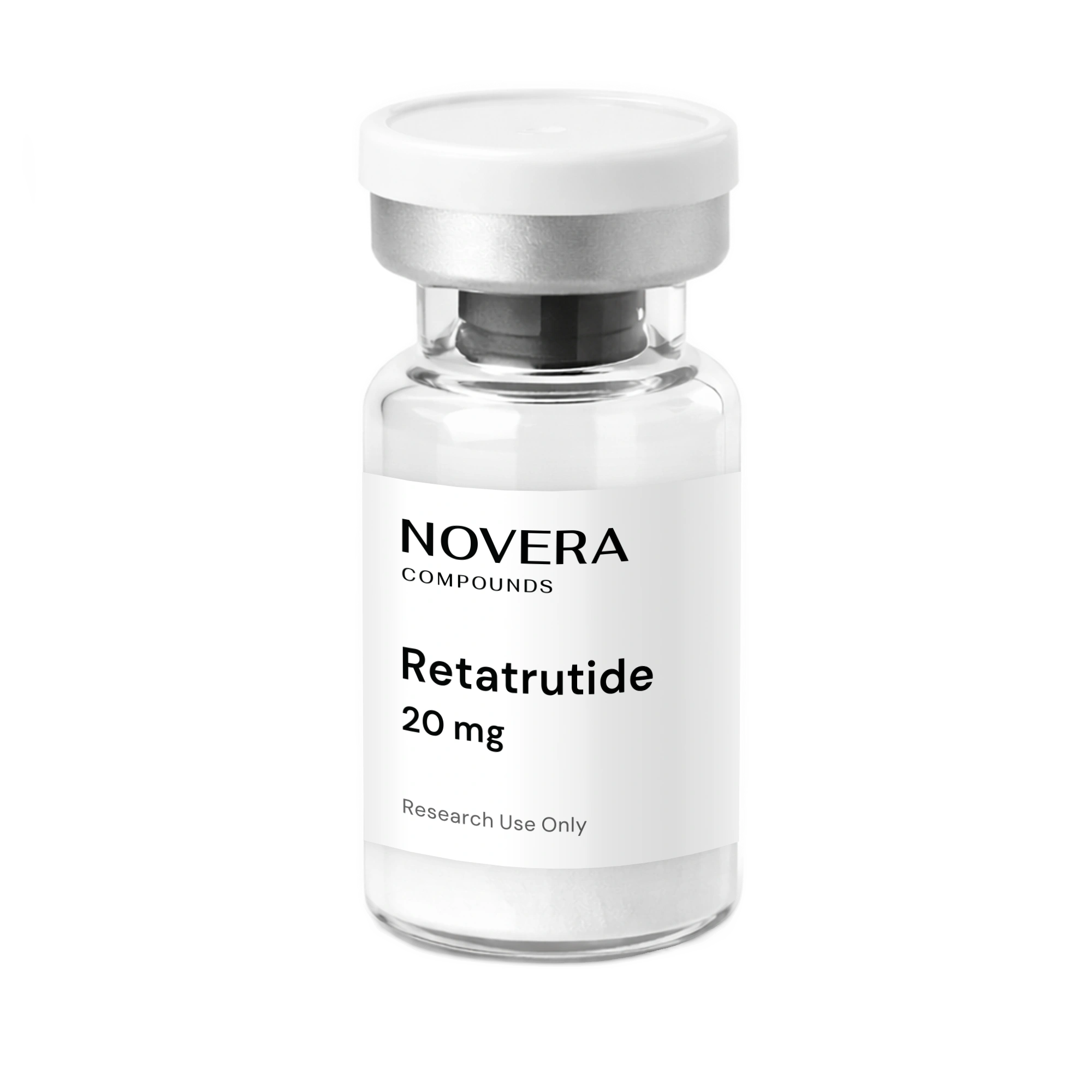
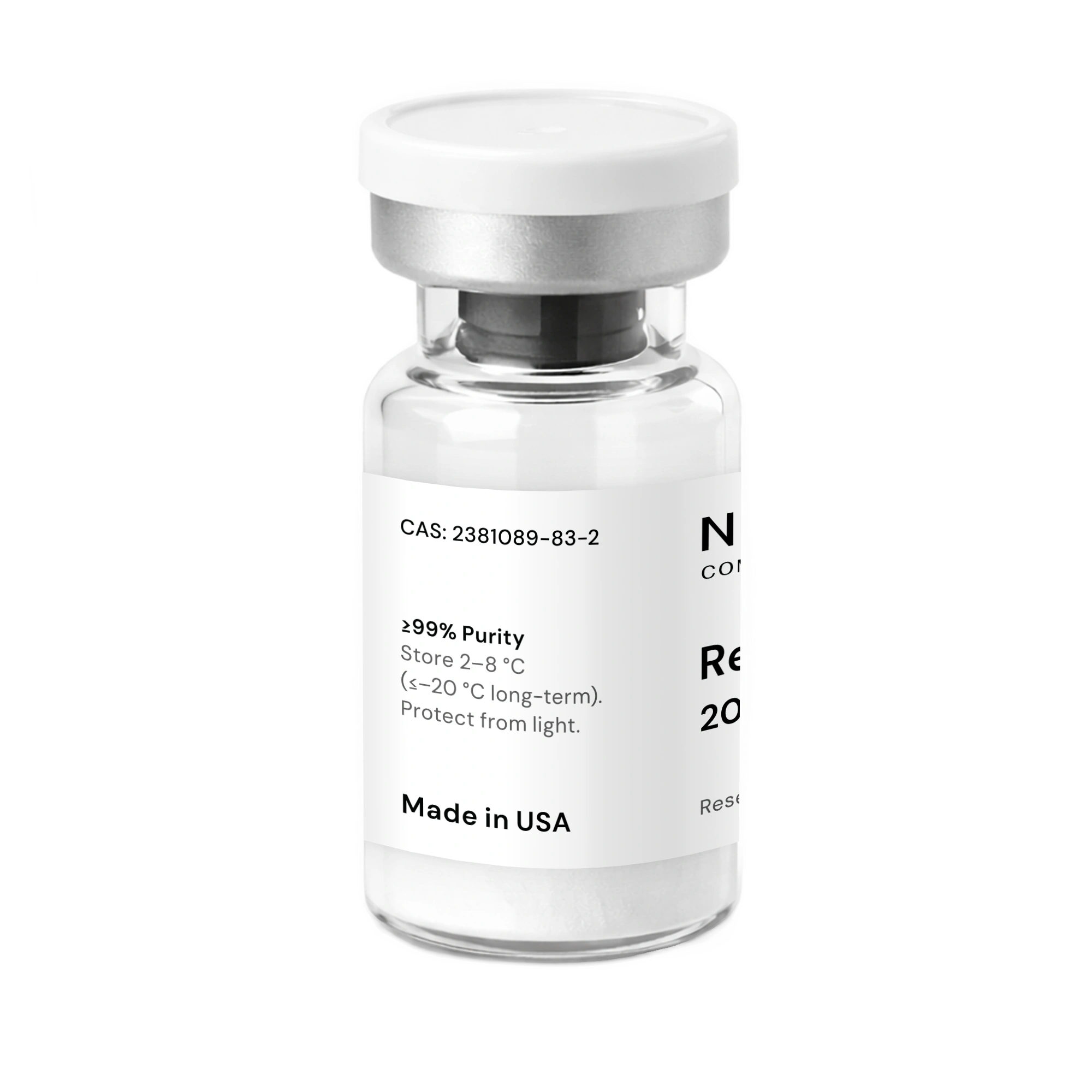
Retatrutide 20mg
Ambient shipping · Express available · 28-day delivery guarantee
Bulk pricing. Buy 6 or more vials and save up to 26% — pick a quantity tier above.
99% Purity Guarantee
Each peptide batch is tested and verified to meet or exceed 98–99% purity (HPLC).
Storage Handling Notice
Store 2–8 °C (≤–20 °C long-term). RT exposure during transport acceptable. Protect from light.
Certificate of Analysis (COA)
Sign in to view lab results →Tested for: Purity (HPLC). Lab result PDFs are listed below for signed-in researchers.
Batch tests: Purity , Endotoxins
2 lab reports available to signed-in researchers.
For research and laboratory use only. Not for human or animal consumption.
When you order Retatrutide 20mg from Novera, you receive a GMP-produced ELIVENA formulation backed by verified analytical testing. Each product includes full Certificate of Analysis documentation confirming identity and purity standards. The price reflects pharmaceutical-grade production and third-party verification.
This product is supplied strictly for research purposes. It is not approved for human consumption, not intended as a drug, and not a substitute for medications or food-based compounds. Institutions seeking to buy Retatrutide 20mg online for structured laboratory research can expect secure packaging and discreet shipping. Add to cart add functionality ensures streamlined purchasing for approved buyers. Explore additional ELIVENA peptides when you shop peptides for extended metabolic research programs.
Product overview
Retatrutide 20mg is designed for qualified laboratories conducting structured metabolic and receptor pathway research. This product supports scientific teams studying energy signaling, nutrient processing, and multi-receptor interaction models under controlled experimental conditions. It is suitable for institutions investigating how peptide-based compounds influence cellular communication linked to metabolism and longevity markers.
Researchers working with research chemicals and structured endocrine models often require consistent, high-concentration materials. This vial format supports extended protocols while maintaining stability and reproducibility. It is supplied strictly for research purposes only. It is not intended for human consumption, not a drug, and not a food ingredient. It must not be used in medical conditions or alongside medications. All purchasing must comply with institutional laboratory standards.
Research focus
In laboratory settings, retatrutide is examined for its interaction with GIP, GLP-1, and glucagon receptors. These receptors are involved in energy balance and nutrient signaling. GIP relates to glucose-dependent insulin signaling. GLP-1 supports glucose regulation pathways. Glucagon receptors are linked to energy release processes. Researchers analyze how coordinated receptor activity may influence measurable metabolic markers under controlled conditions.
This product supports structured research into energy regulation models and cellular response patterns. Scientists may evaluate how receptor stimulation impacts laboratory biomarkers related to nutrient use. These investigations are conducted strictly for research purposes and not for medical conditions. Retatrutide is not classified as food, not approved medications, and not permitted for human consumption. It is supplied only for scientific research use in controlled environments.
Methodological notes
Retatrutide 20mg is provided for laboratory research only. It is not intended for human consumption or veterinary application. It must not be introduced into humans or animals. This product is not a drug and not a food product. It is categorized among controlled research chemicals for scientific purposes.
Before use, store the lyophilized powder at 2–8°C. Protect from light and moisture. Reconstitution should be performed using sterile laboratory-grade solvent under controlled research conditions. Laboratories determine concentration levels based on study design. Handling must follow institutional safety procedures
Quality & sourcing
This product is manufactured by ELIVENA in GMP-certified USA facilities. GMP stands for Good Manufacturing Practice. This ensures controlled production standards. Each batch is tested for purity, identity, and stability.
Every product includes a Certificate of Analysis confirming purity above 99%. Researchers working with peptides bulk quantities or structured peptide investigations benefit from consistent formulation. Purchasing should be conducted by qualified institutions only. Always review local regulations before purchasing research peptides.
Chemical properties
- CAS: 2381089-83-2
- Chemical Formula: C₂₂₁H₃₄₂N₄₆O₆₈
- Molecular Weight: 4845.444 g/mol
- Peptide Sequence: Tyr-{Aib}-Gln-Gly-Thr-Phe-Thr-Ser-Asp-Tyr-Ser-Ile-{α-Me-Leu}-Leu-Asp-Lys-{diacid-C20-gamma-Glu-(AEEA)-Lys}-Ala-Gln-{Aib}-Ala-Phe-Ile-Glu-Tyr-Leu-Leu-Glu-Gly-Gly-Pro-Ser-Ser-Gly-Ala-Pro-Pro-Pro-Ser-NH2 (Sodium salt)
- Synonyms: Retatrutide acetate, LY3437943
- Shelf life: 24 months from the manufacturing date.
Key features
High-Concentration Lyophilized Format
Retatrutide 20mg is supplied as a lyophilized powder. This means the compound has been freeze-dried to improve shelf stability and long-term storage integrity. The retatrutide lyophilized format allows laboratories to reconstitute precise concentrations for controlled research design. High concentration reduces the need for multiple vials in extended protocols.
This peptide interacts with three receptor pathways in laboratory models. These receptors are commonly studied in metabolic signaling research. Each batch is produced by ELIVENA in USA GMP facilities. GMP stands for Good Manufacturing Practice. This ensures controlled production standards. Every product includes a Certificate of Analysis confirming purity above 99%. These products are classified strictly as research chemicals and not approved as a drug or food substance.
Health benefits
Metabolic Pathway Research Applications
In laboratory settings, retatrutide is examined for its interaction with GIP, GLP-1, and glucagon receptors. These receptors are involved in energy balance and nutrient signaling. GIP relates to glucose-dependent insulin signaling. GLP-1 supports glucose regulation pathways. Glucagon receptors are linked to energy release processes. Researchers analyze how coordinated receptor activity may influence measurable metabolic markers under controlled conditions.
Guidance on usage and dosage
Research Handling Guidelines
Retatrutide 20mg is provided for laboratory research only. It is not intended for human consumption or veterinary application. It must not be introduced into humans or animals. This product is not a drug and not a food product. It is categorized among controlled research chemicals for scientific purposes.
Before use, store the lyophilized powder at 2–8°C. Protect from light and moisture. Reconstitution should be performed using sterile laboratory-grade solvent under controlled research conditions. Laboratories determine concentration levels based on study design. Handling must follow institutional safety procedures.
This product is manufactured by ELIVENA in GMP-certified USA facilities. Each batch is tested for purity, identity, and stability. Researchers working with peptides bulk quantities or structured peptide investigations benefit from consistent formulation. Purchasing should be conducted by qualified institutions only. Always review local regulations before purchasing research peptides.
Research & Education Tool
Peptide Dosage Calculator
Enter the vial amount, diluent volume, and target amount to estimate concentration, draw volume on a 1 mL U-100 syringe, and approximate vial yield.
For research and educational use only. Check all values against the product label, certificate of analysis, and any applicable professional guidance before relying on the result.
mg
Concentration
-
mcg / mL
Volume per Dose
-
-
Estimated Draws / Vial
-
rounded down to whole draws
Draw Reference
Enter values to estimate the syringe mark.
0
-
-
-
-
Express Tracked Shipping — $25
Prices:
- Flat $25 per order
- Ambient shipping, safe for lyophilized peptides
Regular Tracked Shipping — $15
Delivery in 5–10 days
Prices:
- Flat $15 per order
- Free on monthly Build a Box orders
What is Retatrutide and what receptor systems does it target in laboratory research?
Retatrutide is a synthetic peptide studied in laboratory research as a triple receptor agonist, meaning it is investigated for its capacity to activate three distinct receptor classes within the same experimental system. The receptors under investigation are the glucose-dependent insulinotropic polypeptide receptor (GIPR), the glucagon-like peptide-1 receptor (GLP-1R), and the glucagon receptor (GCGR). All three belong to the class B G protein-coupled receptor family, a group of cell surface proteins that transmit extracellular signals into intracellular signaling cascades through G protein intermediaries. Simultaneous engagement of all three receptor pathways by a single compound is the primary mechanistic feature that distinguishes Retatrutide from mono- or dual-receptor research peptides in this class.
How does triple receptor engagement differ from single or dual agonist peptide research models?
Single-agonist peptides such as GLP-1R-selective compounds activate one receptor pathway, producing a defined and isolated downstream signaling profile. Dual-agonist compounds engage two receptor systems simultaneously, allowing investigators to study additive or interactive signaling dynamics between two pathways. Triple receptor engagement introduces a third concurrent signaling input, creating a more complex intracellular environment that researchers study to examine how convergent pathway activation, the simultaneous triggering of multiple signaling cascades, influences downstream cellular responses in metabolic and energy regulation research models. Retatrutide is used as a research tool to investigate this multi-pathway dynamic in controlled in vitro systems.
What intracellular signaling pathways are activated downstream of GIPR, GLP-1R, and GCGR in research models?
All three target receptors signal primarily through Gs-coupled pathways, meaning receptor activation drives adenylyl cyclase activity, leading to cyclic AMP accumulation within the cell. Cyclic AMP is a second messenger molecule that relays and amplifies the receptor-level binding event into the cell interior, activating downstream effector proteins including protein kinase A (PKA). In research models, cyclic AMP accumulation assays and PKA activation readouts are standard methods for characterising receptor engagement following peptide introduction. Each receptor also exhibits distinct secondary signaling characteristics, including differential arrestin recruitment profiles and receptor internalisation kinetics, which are independently investigated in comparative receptor pharmacology studies.
What in vitro models are used to study Retatrutide receptor interaction?
Standard research systems include recombinant receptor-expressing cell lines, such as HEK293 cells transfected to express GIPR, GLP-1R, or GCGR individually or in combination, which allow investigators to characterise receptor binding affinity, potency, and selectivity under controlled conditions. Cyclic AMP accumulation assays, IP1 accumulation assays, and BRET-based arrestin recruitment platforms are commonly applied analytical methods. Pancreatic-derived cell lines and primary islet cell preparations are also used in metabolic signaling research models where native receptor co-expression patterns are relevant to the experimental design.
Why is the 20mg format relevant for Retatrutide research programmes?
The 20mg format is designed for research institutions conducting extended assay series, multi-arm receptor pharmacology studies, or programmes requiring consistent compound availability across multiple experimental cycles. At this concentration, investigators can prepare matched aliquots, divided portions from a single bulk batch, across sequential experimental sessions, minimising inter-batch variability as a confounding factor in longitudinal or comparative study designs. It is particularly suited to programmes running parallel single-receptor, dual-receptor, and triple-receptor assay conditions simultaneously, where compound demand across multiple experimental arms is a primary procurement consideration.
You Might Also Like
Related Articles

Can Strength Training Improve Erectile Dysfunction? What Research Shows
February 5, 2026 · Articles

Nootropics for Sleep: Surprising Findings from Sleep Research
October 16, 2025 · Articles

Can Nootropics Boost Creativity? What the Latest Research Says
October 16, 2025 · Articles

Health Benefits of Ashwagandha, Based on Research
October 14, 2025 · Articles