
 Best Sellers
 Metabolic
 Regenerative
 Secretagogues
 Bioregulators
 Neuropeptides






Incretin research now extends beyond single-receptor GLP-1 activation. Researchers compare amylin analogs and dual receptor agonists to map distinct signalling pathways. This article reviews three newer research compounds: Cagrilintide, Mazdutide, and Survodutide.
Beyond GLP-1: Newer Research Compounds
Incretin receptors are cell-surface proteins that normally respond to gut-derived hormones. GLP-1 is the most widely studied incretin receptor target. Drucker (2018) reviews the mechanisms of GLP-1 receptor signalling and its experimental applications. Müller et al. (2019) provide a detailed overview of GLP-1 biology and receptor pharmacology. These sources establish the background for newer compounds that target additional or multiple receptors.

Next-generation compounds include amylin receptor analogs and dual agonists. An amylin analog is a modified version of the natural peptide amylin. A dual agonist is a single molecule that binds and activates two different receptor types. Tschöp et al. (2016) describe the rationale for unimolecular polypharmacy, where one peptide can target multiple metabolic receptors. This concept underpins the development of dual agonists such as Mazdutide and Survodutide.
Cagrilintide
Receptor Profile
Amylin receptors, such as Cagrilintide belong to the calcitonin receptor family. Hay et al. (2015) provide a comprehensive pharmacological characterization of amylin receptor subtypes. They describe receptor composition and signalling properties relevant to laboratory studies.
Lau et al. (2021) describe Cagrilintide as a long-acting amylin analogue in a randomized controlled trial. The term “long-acting” refers to the compound’s stability and extended activity in assay systems.
In laboratory research, Cagrilintide is used to stimulate amylin receptors in cell-based models. Native amylin is unstable and rapidly degraded. A modified analog provides a more stable tool for receptor binding and signalling assays. Hay et al. (2015) note that amylin receptor subtypes differ across tissues, which is important for selecting appropriate cell models.
Research Focus
Studies with Cagrilintide often examine amylin receptor pharmacology. Researchers may measure receptor activation, downstream second messengers, or crosstalk with GLP-1 receptor pathways. Comparative metabolic research can include amylin analogs alongside incretin agonists to assess distinct receptor contributions.
Mazdutide
Receptor Profile
Mazdutide in metabolic research commonly targets GLP-1 and glucagon receptors. Day et al. (2009) demonstrated that a single peptide can activate both glucagon and GLP-1 receptors. Tschöp et al. (2016) further describe the pharmacological basis for combining glucagon and GLP-1 receptor activity in one molecule.
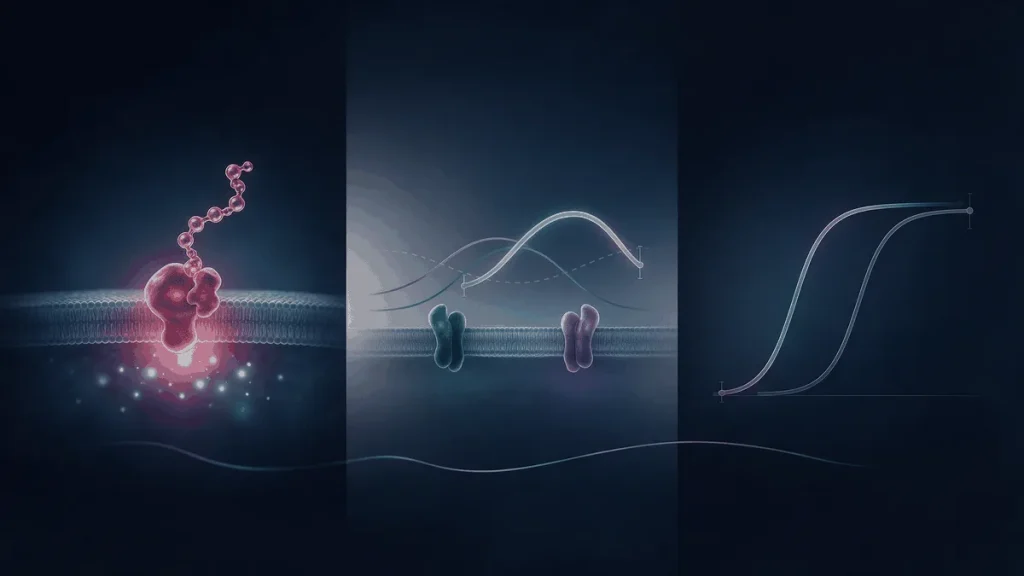
Mazdutide is studied in this dual agonist context. In vitro models allow researchers to examine how simultaneous activation of two receptors changes intracellular signalling. A dual agonist may produce a combined signal that differs from the sum of two separate single-receptor agonists. This makes Mazdutide useful for studying receptor crosstalk.
Product Availability
Dose variants include Mazdutide 5 mg and 10 mg . Researchers can use these products for receptor binding assays, functional signalling studies, and comparative pathway research. All products are for laboratory research only.
Survodutide
Receptor Profile
Like Mazdutide, Survodutide belongs to the broader class of dual GLP-1 and glucagon receptor agonists in general pharmacological literature. Researchers should not assume identical assay behavior between Mazdutide and Survodutide. Structural differences can affect binding kinetics and signalling strength.
Product Availability
Survodutide 6mg supports comparative dual agonist studies. Researchers can run parallel concentration-response curves for Survodutide and Mazdutide under the same assay conditions. This helps identify differences in potency or efficacy in a given model.
Comparison Table
| Feature | Cagrilintide | Mazdutide | Survodutide |
|---|---|---|---|
| Receptor class | Amylin analog | Dual agonist | Dual agonist |
| Receptor targets from general literature | Amylin receptors (Hay et al., 2015) | GLP-1 and glucagon receptors (Day et al., 2009; Tschöp et al., 2016) | GLP-1 and glucagon receptors (Day et al., 2009; Tschöp et al., 2016) |
| Product page listed | Not listed | Mazdutide 10mg | Survodutide 6mg |
| Dose variants mentioned | Not stated | Mazdutide 5/10mg | Survodutide 6mg |
| Research-use-only status | Required for all | Required for all | Required for all |
This table is a research-use-only comparison. It does not imply clinical equivalence.
References
- Day JW, Ottaway N, Patterson JT, et al. A new glucagon and GLP-1 co-agonist eliminates obesity in rodents. Nature Chemical Biology. 2009;5(10):749-757.
- Drucker DJ. Mechanisms of action and therapeutic application of glucagon-like peptide-1. Cell Metabolism. 2018;27(4):740-756.
- Hay DL, Christopoulos G, Christopoulos A, Poyner DR, Sexton PM. Pharmacological characterization of amylin receptors. Pharmacological Reviews. 2015;67(3):564-600.
- Lau DCW, Erichsen L, Francisco AM, et al. Cagrilintide, a long-acting amylin analogue, for weight management: a randomised, dose-finding, phase 2 trial. The Lancet. 2021;398(10317):2160-2172.
- Müller TD, Finan B, Bloom SR, et al. Glucagon-like peptide 1 (GLP-1). Molecular Metabolism. 2019;30:72-130.
- Tschöp MH, Finan B, Clemmensen C, et al. Unimolecular polypharmacy for treatment of diabetes and obesity. Cell Metabolism. 2016;24(1):51-62.