Delivery in 3–5 days
Lab tested · every batch
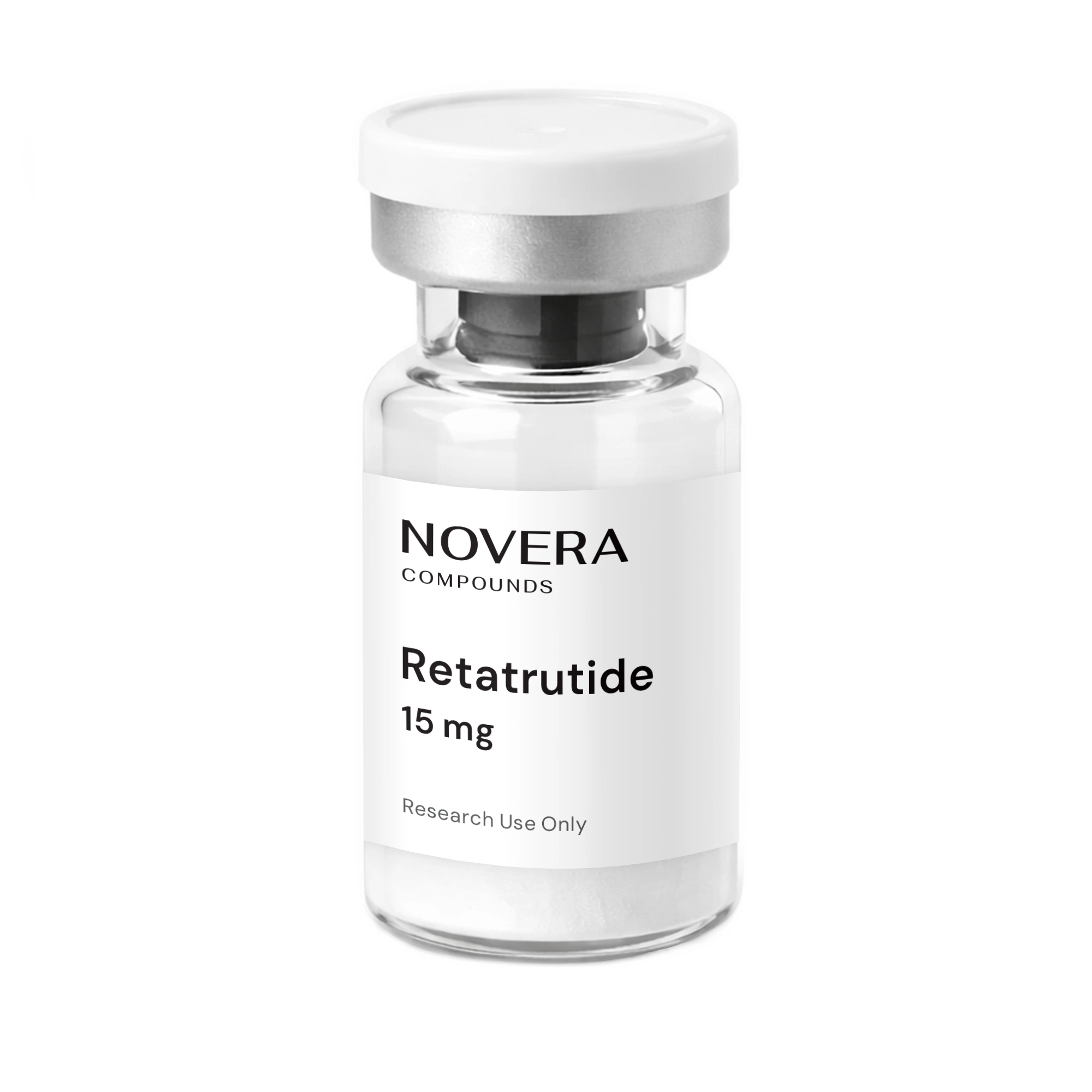
Retatrutide 15mg
Ambient shipping · Express available · 28-day delivery guarantee
Bulk pricing. Buy 6 or more vials and save up to 26% — pick a quantity tier above.
99% Purity Guarantee
Each peptide batch is tested and verified to meet or exceed 98–99% purity (HPLC).
Storage Handling Notice
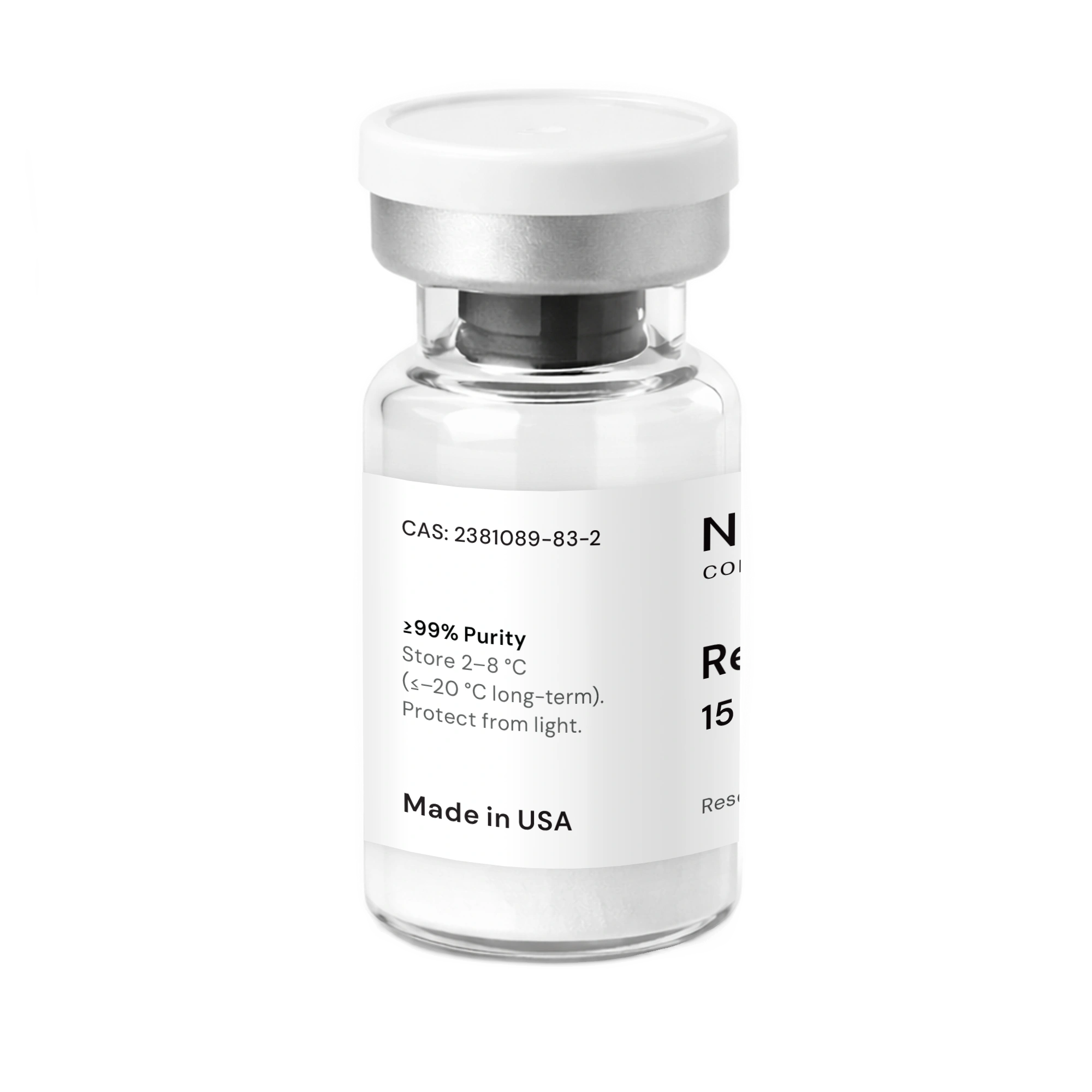
Store 2–8 °C (≤–20 °C long-term). RT exposure during transport acceptable. Protect from light.
Certificate of Analysis (COA)
Sign in to view lab results →Tested for: Purity (HPLC). Lab result PDFs are listed below for signed-in researchers.
Batch tests: Purity
1 lab report available to signed-in researchers.
For research and laboratory use only. Not for human or animal consumption.
Research teams, laboratory coordinators, and institutional procurement departments can order Retatrutide peptide in the 15mg format through a secure, research-use-only ordering process. This compound is supplied exclusively to laboratories and scientific institutions operating within approved research frameworks.
To buy Retatrutide peptide, select the required unit quantity and proceed through the secure checkout. Discreet and reliable delivery is standard across all orders, with packaging engineered to preserve both peptide and acyl modification integrity throughout transit. To order Retatrutide peptide online, institutional purchase orders are accepted alongside standard procurement methods.
This compound is not available by prescription and is not supplied for clinical, therapeutic, veterinary, or personal use.
Product overview
Retatrutide peptide is sourced by research teams investigating how a single synthetic compound simultaneously engages three pharmacologically distinct receptor systems within controlled in vitro environments. GIPR, GLP-1R, and GCGR — the glucose-dependent insulinotropic polypeptide receptor, glucagon-like peptide-1 receptor, and glucagon receptor respectively — are class B G protein-coupled receptors studied extensively in metabolic signaling and energy regulation research models.
Each receptor activates overlapping but distinct intracellular signaling profiles when engaged individually. Retatrutide’s tri-receptor architecture makes it a research tool for investigating how concurrent activation of all three receptor pathways within the same cell-based system produces signaling outputs that differ from those generated by selective mono- or dual-agonist compounds. This multi-pathway convergence is the primary mechanistic question under investigation in Retatrutide-based laboratory research.
The 15mg format is designed for laboratories that have established their assay parameters using smaller quantities and are scaling to full multi-arm experimental protocols — including parallel single-receptor, dual-receptor, and triple-receptor activation comparisons within the same research programme.
Research focus
Retatrutide peptide is investigated in research environments for its concurrent engagement of GIPR, GLP-1R, and GCGR receptor systems expressed in recombinant cell platforms and relevant primary cell models. It is studied within controlled laboratory models examining cyclic AMP accumulation dynamics — cyclic AMP is a second messenger molecule that relays receptor-level binding events into the cell interior — across all three receptor pathways simultaneously, and how tri-receptor co-activation modulates downstream effector protein responses relative to individual receptor stimulation.
The compound is explored for experimental peptide research involving comparative agonist potency profiling across the incretin and glucagon receptor families. Incretin receptors — GIPR and GLP-1R — are studied for their roles in glucose-dependent signaling; GCGR is studied for its role in energy substrate mobilisation signaling. Retatrutide’s capacity to activate all three within a unified experimental framework makes it applicable to multi-pathway convergence studies, receptor cross-talk investigation, and signaling hierarchy mapping in metabolic research models.
Methodological notes
Retatrutide peptide is supplied as a lyophilised powder. Lyophilisation is a freeze-drying process that stabilises the compound in solid form for laboratory storage and preserves peptide and acyl modification integrity prior to experimental use.
Recommended handling conditions:
- Store in a cool, dry environment away from direct light
- Keep sealed until use within a validated laboratory setting
- Protect from moisture and heat exposure at all storage stages
- Reconstitution — dissolving the compound in a suitable laboratory-grade solvent — must be performed by qualified research personnel within an institutional laboratory environment
- Following reconstitution, store under conditions specified in the accompanying analytical documentation
- Handle exclusively within regulated research facilities in compliance with applicable institutional review standards
This compound is not intended for use outside approved laboratory environments
Quality & sourcing
Each unit of Retatrutide peptide undergoes quality control testing prior to dispatch. Peptide purity is verified through high-performance liquid chromatography (HPLC), confirming compound concentration and the absence of significant impurities across both the peptide sequence and acyl modification components. Mass spectrometry is applied to validate molecular identity and confirm acylation integrity within the compound structure.
Batch-to-batch consistency is maintained through internal quality assurance standards across all production runs. Each pack size is accompanied by analytical documentation providing peptide purity data, molecular identity confirmation, and batch identifiers. This supports reproducible research peptide supply to institutions and laboratories in the United States and internationally, and meets the documentation requirements of structured tri-receptor pharmacology research programmes.
Chemical properties
- CAS: 2381089-83-2
- Chemical Formula: C₂₂₁H₃₄₂N₄₆O₆₈
- Molecular Weight: 4845.444 g/mol
- Peptide Sequence: Tyr-{Aib}-Gln-Gly-Thr-Phe-Thr-Ser-Asp-Tyr-Ser-Ile-{α-Me-Leu}-Leu-Asp-Lys-{diacid-C20-gamma-Glu-(AEEA)-Lys}-Ala-Gln-{Aib}-Ala-Phe-Ile-Glu-Tyr-Leu-Leu-Glu-Gly-Gly-Pro-Ser-Ser-Gly-Ala-Pro-Pro-Pro-Ser-NH2 (Sodium salt)
- Synonyms: Retatrutide acetate, LY3437943
- Shelf life: 24 months from the manufacturing date.
Retatrutide is a chemically synthesised acylated peptide analogue. Acylation is a chemical modification in which a fatty acid chain is attached to the peptide backbone — a structural feature that influences the compound’s interaction with plasma proteins and its behaviour in aqueous laboratory environments. This modification class is studied in peptide research for its effect on receptor binding kinetics and compound stability under experimental conditions.
The peptide’s sequence is engineered to achieve balanced potency across all three target receptors — GIPR, GLP-1R, and GCGR — within a single molecular structure. Achieving concurrent multi-receptor engagement from a single peptide sequence requires structural optimisation at residue positions that determine contact geometry with each receptor’s orthosteric binding site. An orthosteric binding site is the primary binding location on a receptor where its natural ligand — the molecule it is designed to bind — makes contact. This structural engineering is itself a subject of investigation in comparative receptor pharmacology and peptide structure-activity relationship research.
Key features
- Synthetic peptide engineered for simultaneous engagement of three distinct class B G protein-coupled receptors — GIPR, GLP-1R, and GCGR — within a single experimental system, representing the most mechanistically complex receptor co-activation research tool in the metabolic peptide research category
- 15mg pack size positioned between entry-scale and high-volume formats, suited to research programmes that have completed pilot-phase assay development and are running structured multi-arm receptor pharmacology investigations
- High-purity compound, batch-tested and verified through HPLC and mass spectrometry prior to dispatch
- Secure packaging and discreet shipment as standard for institutional and laboratory procurement
Research & Education Tool
Peptide Dosage Calculator
Enter the vial amount, diluent volume, and target amount to estimate concentration, draw volume on a 1 mL U-100 syringe, and approximate vial yield.
For research and educational use only. Check all values against the product label, certificate of analysis, and any applicable professional guidance before relying on the result.
mg
Concentration
-
mcg / mL
Volume per Dose
-
-
Estimated Draws / Vial
-
rounded down to whole draws
Draw Reference
Enter values to estimate the syringe mark.
0
-
-
-
-
Express Tracked Shipping — $25
Prices:
- Flat $25 per order
- Ambient shipping, safe for lyophilized peptides
Regular Tracked Shipping — $15
Delivery in 5–10 days
Prices:
- Flat $15 per order
- Free on monthly Build a Box orders
What is Retatrutide and what receptor systems does it target in laboratory research?
Retatrutide is a synthetic acylated peptide studied as a triple receptor agonist, investigated for its simultaneous engagement of three class B G protein-coupled receptors: GIPR, GLP-1R, and GCGR. Its acylated structure — incorporating a fatty acid chain modification — influences receptor binding kinetics and compound behaviour in aqueous laboratory environments, both of which are studied as experimental variables in receptor pharmacology research.
How does triple receptor engagement differ from mono- and dual-agonist research models?
Single-agonist peptides generate isolated, attributable signaling profiles from one receptor pathway. Dual-agonists allow study of additive or interactive dynamics between two converging pathways. Triple receptor engagement introduces a third concurrent Gs-coupled signaling input, enabling investigators to examine how cyclic AMP accumulation and downstream effector responses are modulated when all three pathways are activated in parallel versus individually.
What intracellular signaling pathways are activated downstream of GIPR, GLP-1R, and GCGR?
All three receptors signal primarily through Gs-coupled adenylyl cyclase activation, driving cyclic AMP accumulation and downstream protein kinase A activation. Each receptor also exhibits distinct secondary signaling characteristics — including differential arrestin recruitment kinetics and receptor internalisation profiles — which are investigated using selective mono-agonist reference compounds in parallel assay designs.
What in vitro models are used to study Retatrutide?
Standard systems include HEK293 cell lines stably expressing GIPR, GLP-1R, and GCGR individually, in pairwise combinations, or all three together. Cyclic AMP accumulation assays, BRET-based arrestin recruitment platforms, and pancreatic islet-derived cell models are commonly applied. Selective antagonist controls confirm individual receptor contributions within triple-receptor assay designs.
Is Retatrutide intended for human or veterinary use?
No. Retatrutide as supplied is for research use in controlled laboratory settings only. It is not approved for human administration, therapeutic use, veterinary application, or any purpose outside formally regulated in vitro research programmes.